
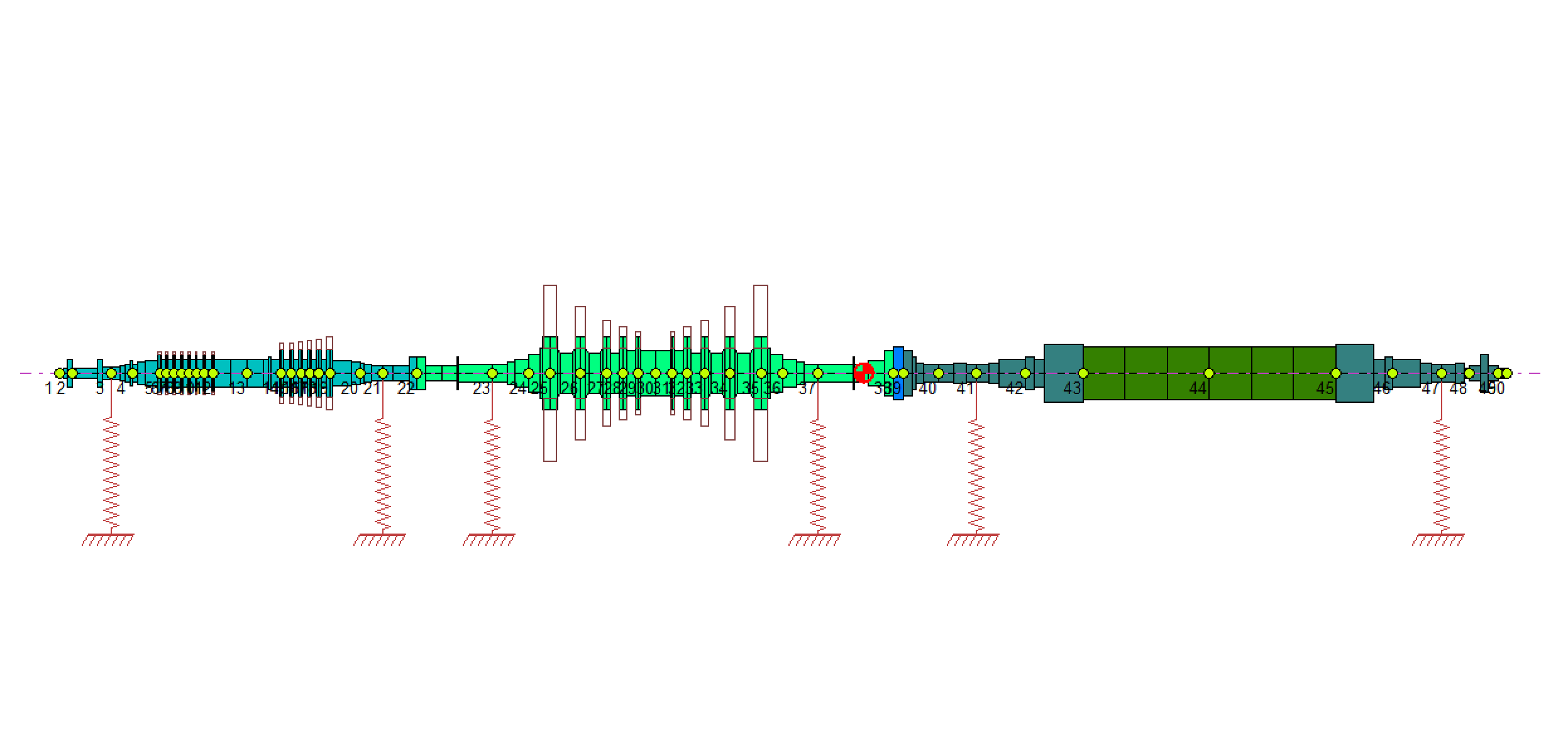
[vc_row][vc_column][mkd_section_title title_tag=”h3″ enable_separator=”no” title=”Lateral Vibration Analysis”]Lateral vibration of a shaft rotor is due to instability, unbalance, or other forces acting on the rotor. Lateral Analysis (also called Rotordynamics Analysis) simulates the rotating system, calculates the critical speeds, predicts vibration amplitudes, and provides recommendations to reduce vibration risks.
 |
[/mkd_section_title][vc_column_text]SCOPE of work: ANALYSIS FEATURES
The scope is API Compliant (including but not limited to 610, 617, 619, and RP 684). The modeling and analysis include these activities:
Undamped Critical Speed Analysis
- Prepare the rotor dynamic model to simulate the entire system.
- Determine critical speeds over a range of bearing stiffnesses.
- Calculate the mode shapes, eigenvalues, and critical speeds.
Damped Eigenvalue (Critical Speed) Analysis
- Calculate modes across the speed range.
- Damped eigenvalue analysis of critical speeds of the rotor with the actual bearing stiffness and damping coefficients; damping evaluated using several methods.
- Separation margins evaluated per API requirements usually 10% to 15% depending on other factors.
Forced Response Analysis
- Calculate the unbalanced vibration response amplitudes and critical speed locations based on API recommended unbalanced guidelines.
- Evaluate the separation margins for a range of bearing clearances.
 |
| Unbalanced response calculated using API recommended approach |
Stability Analysis
- Evaluate oil whirl and shaft whip to avoid self-excited instabilities.
- Calculate damped eigenvalues.
Transient and Nonlinear Analysis
- Using the Time Domain solver on DYROBIS, evaluate blade-loss, rubs, and other events as the system decelerates through critical speeds.
Quality Checks and Reporting
- Perform technical review to ensure validity of model and inputs.
- Issue report containing detailed results of the Lateral Analysis, separation margins, design acceptance (or not), and recommendations if required.
ESG ADVANTAGES
- Integrated engineering capabilities to support all vibration-related design and field engineering for compressors, pumps, and piping systems.
- Large torsional and lateral vibration analysis team – including field engineers.
- Global support for OEMs, end users, and engineering consulting firms.
- Accurate software for Lateral Analysis with DYROBES & ANSYS.
RELATED SERVICES
- TORSIONAL VIBRATION ANALYSIS (TVA)
- SURGE CONTROL DYNAMIC ANALYSIS FOR CENTRIFUGAL COMPRESSOR SYSTEMS
- FLOW-INDUCED VIBRATION ANALYSIS
- FLOW-INDUCED TURBULENCE ANALYSIS
- ACOUSTIC INDUCED VIBRATION ANALYSIS (ESG sub’s these services)
RELATED INFORMATION[/vc_column_text][mkd_image_gallery type=”image_grid” column_number=”2″ pretty_photo=”no” grayscale=”no” images=”3519,3520,3521,3522″ image_size=”large”][/vc_column][/vc_row]